
UFC Sacramento Breakdown: Anthony Hernandez vs. Gregory Rodrigues
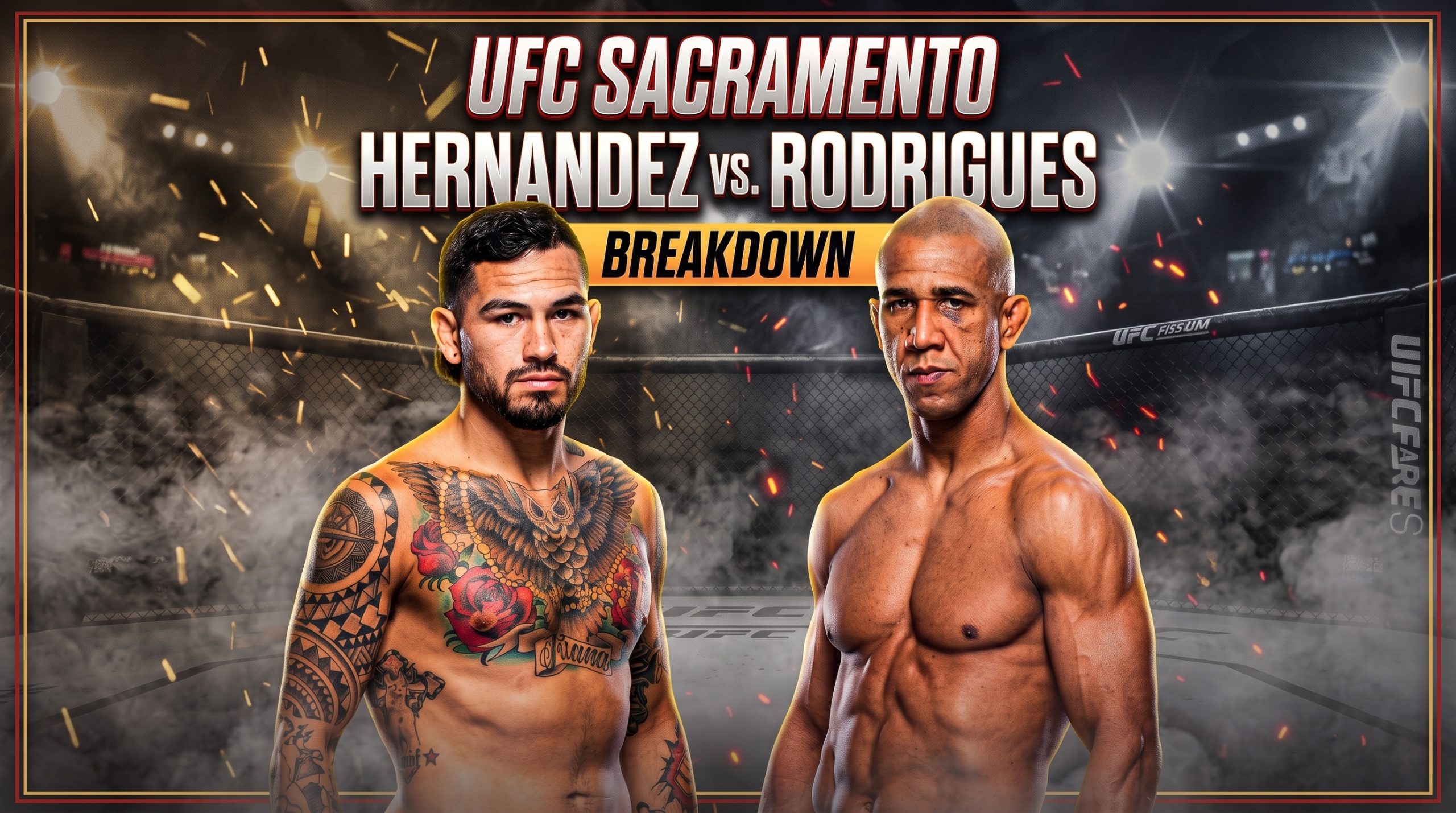
Anthony Hernandez and Gregory Rodrigues headline UFC Sacramento on Saturday at Golden 1 Center in a middleweight main event. Hernandez is 15-3 and ranked No. 6 at middleweight, while No. 11 Rodrigues comes in at 19-6 with a 10-3 UFC mark. The event takes place Saturday, August 22, in Sacramento, California, with the main card beginning at 8 p.m. ET.
Hernandez enters as the established favorite, carrying a suffocating pace, elite submission volume, and a reputation for turning fights into exhausting grappling marathons. Rodrigues, meanwhile, brings the type of concussive power that can erase every statistical edge in one exchange. The Brazilian is the underdog, but he is not being asked to manufacture a miracle. He is being asked to survive the initial wrestling storm, force Hernandez into extended striking exchanges, and make “Fluffy” pay for the defensive holes that were badly exposed in his last outing.
This is a classic striker-versus-pressure-grappler matchup on paper, but it is more complicated in practice because Rodrigues is not merely a dangerous puncher. He is a high-level Brazilian jiu-jitsu practitioner and former Brazilian national BJJ champion with international freestyle wrestling experience.
That background is the reason this fight is worth a closer betting look. Hernandez’s entire game is built around breaking opponents with pace, chain wrestling, top pressure, and attritional damage. Rodrigues has the physicality and grappling competence to make that first phase considerably harder than the market may be accounting for. If he can do that, this main event can swing quickly from a cardio test into a fire fight where “Robocop” owns the more destructive weapons.
Odds and Market Read
The current market lists Hernandez as the favorite, while Rodrigues is priced as a live underdog. The line reflects a real stylistic edge for Hernandez over 25 minutes, but it also gives bettors a reasonable price on the fighter with the more immediate finishing threat.
| Markets | Anthony Hernandez | Gregory Rodrigues |
|---|---|---|
| Moneyline | -188 | +152 |
| Implied probability | 65.3% | 39.7% |
| Round Total | Over 2.5 rounds (-106) | Under 2.5 rounds (-122) |
| Win by KO/TKO | +300 | +240 |
| Win by submission | +260 | +1500 |
| Win by decision | +470 | +1200 |
The moneyline pricing makes Hernandez roughly a 65% favorite before accounting for sportsbook hold, while Rodrigues’ +152 number implies a substantially lower chance than his actual upside suggests. That does not mean Hernandez is incorrectly favored. His pace, sustained grappling, and five-round experience give him the more stable win condition. It does mean Rodrigues is being priced like a one-dimensional puncher when his defensive grappling pedigree gives him a legitimate pathway to turn the fight into his preferred kind of contest.
The total is also revealing. A 2.5-round line with the under slightly favored indicates the market expects a finish before we even hit the championship rounds. But this is precisely where a Rodrigues position becomes interesting: if he can hold up under the early wrestling entries and win exchanges at range, the assumed late Hernandez takeover may never arrive.
Hernandez’s Relentless Engine
Hernandez has built a deserved reputation as one of the division’s most demanding fighters to deal with. He averages 5.88 takedowns and 1.63 submissions per 15 minutes, numbers that speak to more than just wrestling volume. He uses failed shots to create clinches, uses clinches to create scrambles, and uses scrambles to exhaust opponents until they start accepting bad positions. His output is designed to make every minute uncomfortable. Even when he is not scoring clean takedowns, he forces opponents to defend, pummel, frame, post, and fight off the fence repeatedly.
That style fueled an eight-fight winning streak before Sean Strickland stopped him in February. The streak included a one-sided dismantling of Michel Pereira, a performance that made Hernandez look like a possible title challenger rather than simply another difficult top-10 gatekeeper. He is a pressure fighter in the truest sense: he does not need a single clean path to victory because he can create five or six smaller advantages every round.
The concern is that Hernandez can be defensively available while pressing forward. He absorbs 3.10 significant strikes per minute, and the Strickland loss showed that a composed, accurate striker can intercept his entries and make him pay before the grappling starts. Strickland landed 110 significant strikes in fewer than three rounds while Hernandez landed only 55. The defining sequence came when Hernandez’s forward pressure was met by sharp jabs and a damaging knee to the body.
Hernandez’s urgency is normally an asset, but against a power puncher who is comfortable throwing combinations in the pocket, urgency can become a liability. Rodrigues does not have Strickland’s patient, range-oriented counter game, but he has more finishing power and far more willingness to turn the pocket into a brawl.
Rodrigues Has More Than a Puncher’s Chance
Rodrigues is riding a three-fight winning streak and has won seven of his last eight. His recent surge includes a decision over Roman Kopylov, a brutal stoppage of Jack Hermansson, and a first-round knockout of Brunno Ferreira in March. The Ferreira result was especially meaningful because it avenged a 2023 knockout defeat and demonstrated that Rodrigues has developed the patience to learn from adversity rather than simply trying to overwhelm every opponent in front of him.
The Brazilian’s primary winning statistic remains power. He throws with bad intentions, and he is capable of ending a fight with hooks in close range, short uppercuts in the clinch, or a sudden burst when an opponent reaches too recklessly for a takedown. Hernandez’s style creates those opportunities. He comes forward, changes levels often, and can be caught during the moments between striking and wrestling.
The analytical case for Rodrigues is not merely, he hits hard, therefore he can win. It is that the best version of his opponent relies heavily on a grappling game that may be harder to enforce here than it has been in recent fights. Rodrigues has legitimate high-level jiu-jitsu credentials and wrestling experience, even though he usually chooses to keep fights on the feet and hunt damage. If Hernandez shoots from too far out or commits to predictable entries, Rodrigues has the awareness to defend, frame off, regain his feet, and punish the break.
That distinction matters. Hernandez is outstanding when he can establish top control and turn a fight into a long physical grind. But he is not facing an opponent who will panic simply because the bout hits the canvas. Rodrigues has the composure to survive difficult positions and the technical ability to make Hernandez work for every minute of control.
The First Seven Minutes Decide Everything
This is one of those main events where the most important wager may be based on time, not just the eventual winner. Hernandez has been in two five-round fights and picked up finishes in the fourth and fifth rounds. Rodrigues has only gone into the championship rounds once in the UFC, when he nearly finished Jared Cannonier early but was stopped in the fourth. Those facts explain why Hernandez is favored. His cardio has held up in extended fights, while Rodrigues’ worst-case scenario has always been a long fight where he spends too much time defending.
But the early rounds favor Rodrigues in a meaningful way. Hernandez must close distance, initiate the grappling, and make the bout ugly. Rodrigues can work behind his punches, punish a level change, and force Hernandez to take physical damage just to reach his best positions. The longer Hernandez remains stuck in striking range, the more his defensive liabilities become relevant.
A critical tactical detail will be Hernandez’s first takedown attempt. If he can chain a shot into a body lock, trip Rodrigues, and establish top control inside the opening two minutes, it will validate the favorite’s price immediately. If Rodrigues stuffs that first sequence, circles off the fence, and lands a clean combination on the exit, the entire bout changes. Hernandez will still have time to wrestle, but he will have to think about every entry. That hesitation is poisonous for a pressure fighter whose effectiveness depends on being willing to repeat attacks without fear.
The Striking Matchup Favors Robocop
Rodrigues needs this fight contested primarily in the pocket and at boxing range. He should not chase Hernandez wildly, because that would hand him the clinches and takedowns he wants. Instead, he needs to meet the forward pressure with compact combinations, especially the jab-to-right-hand sequences and short hooks when Hernandez ducks toward the hips.
Hernandez is more functional than elegant on the feet. His striking often exists to disguise a level change rather than to win prolonged exchanges. That has worked because the threat of his wrestling makes opponents tentative. Rodrigues should be one of the few middleweights willing to return fire immediately after defending a shot, rather than accepting separation and resetting without consequence.
The Marc-Andre Barriault fight provides an instructive reference point. Hernandez was able to survive a dangerous striking moment, return to his game, secure takedowns, and eventually find an arm-triangle submission. But Barriault is not Rodrigues on the mat. Rodrigues is the more credible defensive grappler and the more dangerous fighter in a scramble. Hernandez may get takedowns, but he will have a much harder time turning them into the prolonged, energy-sapping control stretches that make his style so effective.
The Contrarian Betting Case
Most will understandably lean toward Hernandez’s relentless pace and superior five-round resume. Some projections have him as high as a 60% favorite, and his statistical advantages in takedown volume and submission activity are substantial.
That is the central betting angle: the market is charging a premium for Hernandez’s pace and reliable late-game identity while offering a plus-money price on the fighter with the cleaner power, more dangerous striking, and enough grappling depth to resist a pure wrestling takeover.
Rodrigues by knockout is the most logical method-of-victory look, particularly in the first three rounds. His route is not to win a slow technical decision; it is to make Hernandez pay for entering on predictable lines. The “fight to start Round 4, No” prop at -170 also aligns with that read, although it is a more expensive way to bet on volatility. If you back Rodrigues outright, the moneyline gives you coverage for a decision or a late finish while preserving a strong return on the underdog.
Final Prediction
Hernandez has the more dependable long-form game. If this becomes a five-round wrestling attrition contest, he should take over as Rodrigues slows down. That is the reason the favorite’s case is legitimate, and it is why this is not a reckless fade of one of middleweight’s best pressure grapplers.
But stylistically, this feels like the right matchup at the right price for Rodrigues. Hernandez’s loss to Strickland exposed the danger of his forward-moving entries against accurate, punishing striking. Rodrigues may not fight with Strickland’s measured style, but he carries much more immediate fight-ending power and has the grappling credentials to make Hernandez earn every inch of control. The Brazilian’s ability to defend early shots, force uncomfortable exchanges, and land the more damaging punches is enough to justify the underdog bet.