
UFC 331 Recap: Joshua Van Outclasses Pantoja as Sean Sharaf Shocks the World
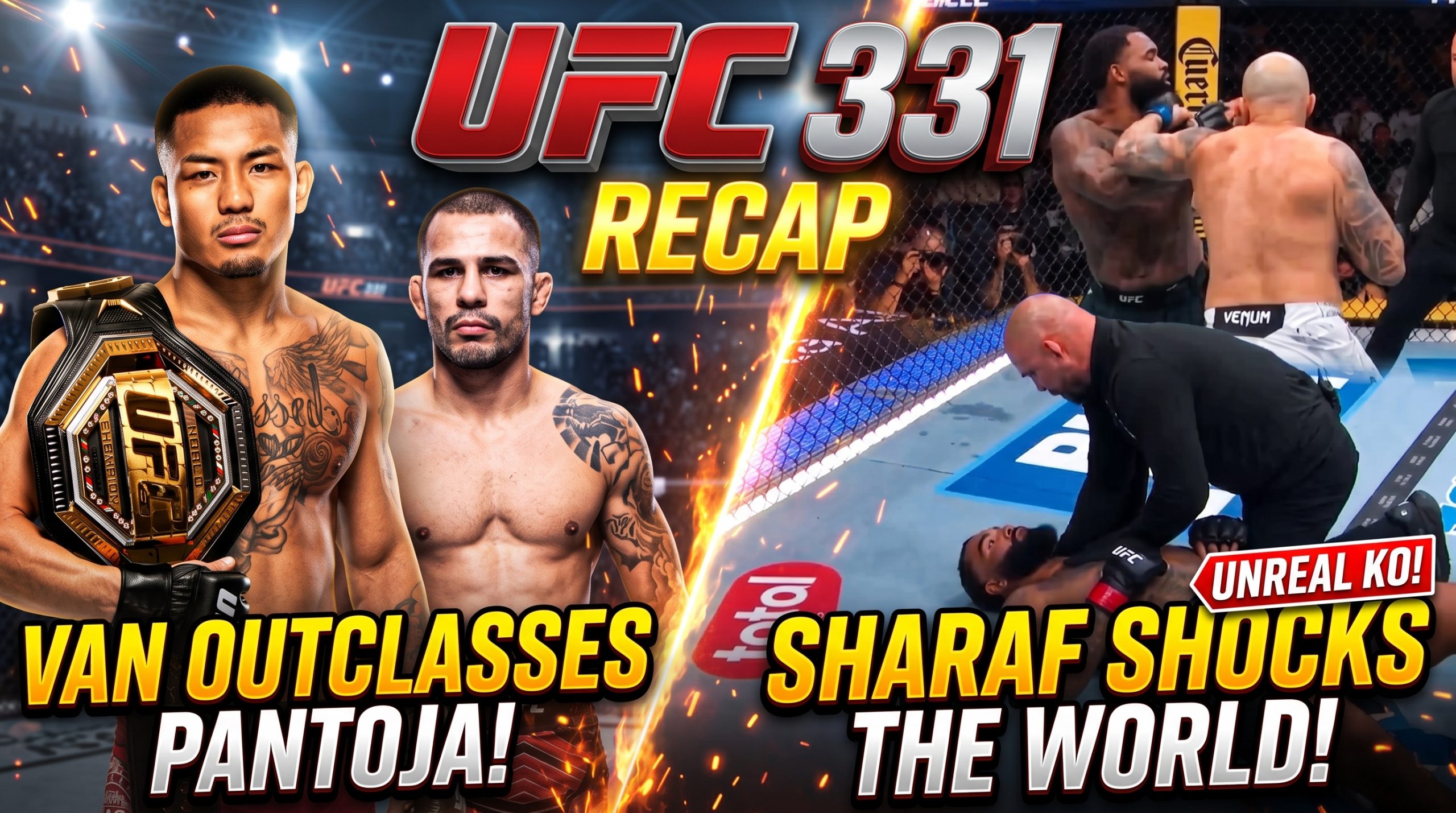
UFC 331 arrived at Crypto.com Arena in Los Angeles with a championship rematch at the top, but the night produced far more than a definitive flyweight result. The card combined a five-round technical showcase, a title-eliminator statement, a veteran resurgence and one of the most dramatic betting upsets in UFC history.
By the end of Saturday night, the promotion had a firmly established champion at 125 pounds, an undeniable lightweight challenger and a heavyweight prospect whose hype disappeared in 12 seconds.
Joshua Van Closes the Pantoja Chapter
Joshua Van entered his rematch with Alexandre Pantoja needing to prove that their first meeting represented a genuine changing of the guard rather than one favorable night. He accomplished that mission by winning a unanimous decision over five high-paced rounds, with the judges returning scores of 49-46, 48-47 and 50-45. The victory marked Van’s second successful flyweight title defense and moved his professional record to 18-2, while Pantoja fell to 30-7.
The tactical difference was Van’s ability to operate at multiple tempos. He could lead with compact combinations, intercept Pantoja’s entries and then accelerate whenever the former champion attempted to turn the fight into a scramble-heavy battle. Pantoja remained dangerous because of his durability, pressure and willingness to exchange, but Van increasingly made him pay for crossing distance without a layered setup.
Van’s composure was just as impressive as his offense. Pantoja has built his reputation by dragging opponents into exhausting, chaotic sequences where clean technique often breaks down. Van refused to become reckless. He stayed organized, reset his feet after exchanges and consistently returned fire before Pantoja could establish prolonged control. That discipline explains why the scorecards were wider than the action sometimes appeared in real time.
The result also carried long-term divisional significance. Van did not simply edge a respected former champion; he beat Pantoja for a second time and did it across 25 minutes in a performance described as one of the best of his young career. The rematch removes much of the lingering debate around their rivalry and allows the champion to move toward fresh challengers instead of remaining tied to the previous era.
Tsarukyan Demands His Title Shot
Arman Tsarukyan entered the co-main event as a substantial favorite over Mauricio Ruffy, but the matchup still carried real danger. Ruffy’s length, timing and explosive counterstriking presented the kind of threat that could punish Tsarukyan whenever he closed distance carelessly. That danger appeared early when Ruffy landed a strong right hand and repeatedly defended Tsarukyan’s takedown attempts.
Tsarukyan’s response revealed why he belongs at the front of the lightweight title queue. Rather than abandoning the clinch after his wrestling stalled, he continued pinning Ruffy against the fence and forced him to defend multiple layers of offense. With four seconds remaining in the opening round, Tsarukyan created just enough separation to land a crushing left elbow, then added another elbow as Ruffy collapsed. The official stoppage came at 4:56 of Round 1.
That finish was especially meaningful because Tsarukyan won outside the path most observers expected. He did not dominate with takedowns or extended top control. Instead, his wrestling pressure created the stationary target for a fight-ending strike. It was a reminder that elite grappling can produce knockouts even when the takedown itself never materializes.
Ruffy’s stock should not collapse after one defeat. He showed improved takedown defense and landed clean offense against one of the division’s most complete competitors. However, Tsarukyan turned a difficult matchup into a spectacular first-round victory. In a division where contenders can spend years waiting for clarity, this was about as persuasive a title-shot argument as he could make.
Sharaf Produces a Historic Upset
No result at UFC 331 generated more immediate shock than Sean Sharaf knocking out Gable Steveson in 12 seconds. Steveson entered as an overwhelming favorite, tracking a closing range that reached beyond -1000 at major books, while Sharaf was available at four-figure underdog prices. The bout ended before Steveson could initiate a wrestling exchange.
Sharaf stepped forward immediately, fired a right hand and followed it with a perfectly placed left hook. The second punch landed flush on Steveson’s chin and switched off the Olympic champion before his world-class wrestling could become relevant. The result became the third-fastest knockout in UFC heavyweight history and gave Steveson his first professional MMA defeat.
The lesson was brutally simple: credentials do not protect a fighter during open-space exchanges. Steveson possessed the superior wrestling resume and entered with enormous expectations, but his striking defense remained largely untested at the UFC level. Sharaf refused to grant him the time normally afforded to a developing prospect. He attacked immediately, trusted his power and converted one clean opening into a career-changing victory.
For Sharaf, the knockout changes everything. He entered after two UFC losses by stoppage and was widely positioned as an opponent for a heavily promoted prospect. Twelve seconds later, he owned one of the biggest upsets the promotion has ever seen. Steveson remains an extraordinary athlete with a rare grappling foundation, but his developmental plan must now prioritize defensive awareness, responsible entries and the ability to recover when an opponent refuses to concede the center.
Pitbull Turns Back the Clock
Patricio Freire arrived as the betting underdog against Doo Ho Choi, but the former Bellator champion delivered a vintage performance. Pitbull stopped Choi with punches and elbows at 3:28 of Round 1, handing the favored Korean striker a decisive defeat before he could settle into his preferred long-range rhythm.
The key was Pitbull’s ability to close distance without standing directly in front of Choi’s power. Choi remains dangerous when opponents give him clean sightlines and predictable entries, but Pitbull used veteran timing to disrupt that comfort. Once he hurt Choi, he did not allow the exchange to reset. He swarmed with the finishing instincts that defined his championship years.
The win does not automatically place Pitbull near a UFC featherweight title shot, but it restores relevance and gives the promotion several compelling veteran-versus-contender options. More importantly, it demonstrated that his experience remains functional rather than ceremonial. Against a younger favorite, Pitbull still possessed the timing and killer instinct to end a fight in the opening round.
Main Card Underdogs Cash In
Alonzo Menifield added another upset to the main card by defeating Iwo Baraniewski via split decision. Baraniewski entered as the favorite, but Menifield’s physicality, durability and ability to win the heavier exchanges carried two of the three scorecards, 29-28, 28-29 and 29-28.
On the preliminary card, Marlon Vera stopped Charles Jourdain at 2:02 of Round 3. Vera’s historically patient style can cost him rounds, but it becomes dangerous when opponents slow and exchanges become more stationary. Jourdain entered as the betting favorite, yet Vera stayed composed long enough to find the damaging sequence he needed.
Robelis Despaigne defeated Tai Tuivasa by split decision in a heavyweight bout that raised as many questions as it answered. Despaigne earned the victory, but going to a narrow decision against an underdog showed that his extraordinary physical gifts still need greater tactical consistency. Tuivasa, meanwhile, proved difficult to remove but again fell short of creating enough sustained offense to convince two judges.
Prelims Reshape Multiple Divisions
Casey O’Neill produced the preliminary card’s cleanest submission, catching Eduarda Moura with an armbar at 3:22 of Round 1. The finish gave O’Neill a valuable victory in a flyweight division where decisive performances can create rapid movement, especially against an opponent with Moura’s strength and grappling upside.
Joanderson Brito also made quick work of Giga Chikadze, finishing the accomplished kickboxer with ground strikes at 1:57 of the opening round. Brito’s pressure prevented Chikadze from establishing kicking range, and once the fight hit the floor, the Brazilian’s aggression closed the show almost immediately.
Those two bouts reinforced a recurring theme from UFC 331, specialists were most vulnerable when opponents denied them the phase they wanted. Moura could not stabilize the grappling sequence before O’Neill isolated the arm, while Chikadze never received the space required to build a kicking attack. At this level, controlling the terms of engagement often matters more than owning the cleaner résumé in one discipline.
What UFC 331 Changed
UFC 331 provided unusual clarity across several divisions. Van now owns two victories over Pantoja and can move forward as the unquestioned leader of the flyweight class. Tsarukyan transformed clinch pressure into a highlight-reel knockout and strengthened his claim to the next lightweight championship opportunity. Pitbull proved he remains capable of punishing ranked-level opposition, while Menifield and Vera reminded bettors why experienced underdogs are dangerous when a matchup allows them to impose physicality and patience.
The lasting image, however, may be Sharaf’s left hook. Steveson entered as one of the card’s safest favorites and left with his first defeat after only 12 seconds of action. That result captured the central truth of UFC 331, reputations, rankings and betting lines shape expectations, but they cannot survive a perfectly timed strike. On a night when the champion delivered certainty, the heavyweight division delivered pure chaos.