
UFC 331: Is Tsarukyan-Ruffy Next for Lightweight Title?
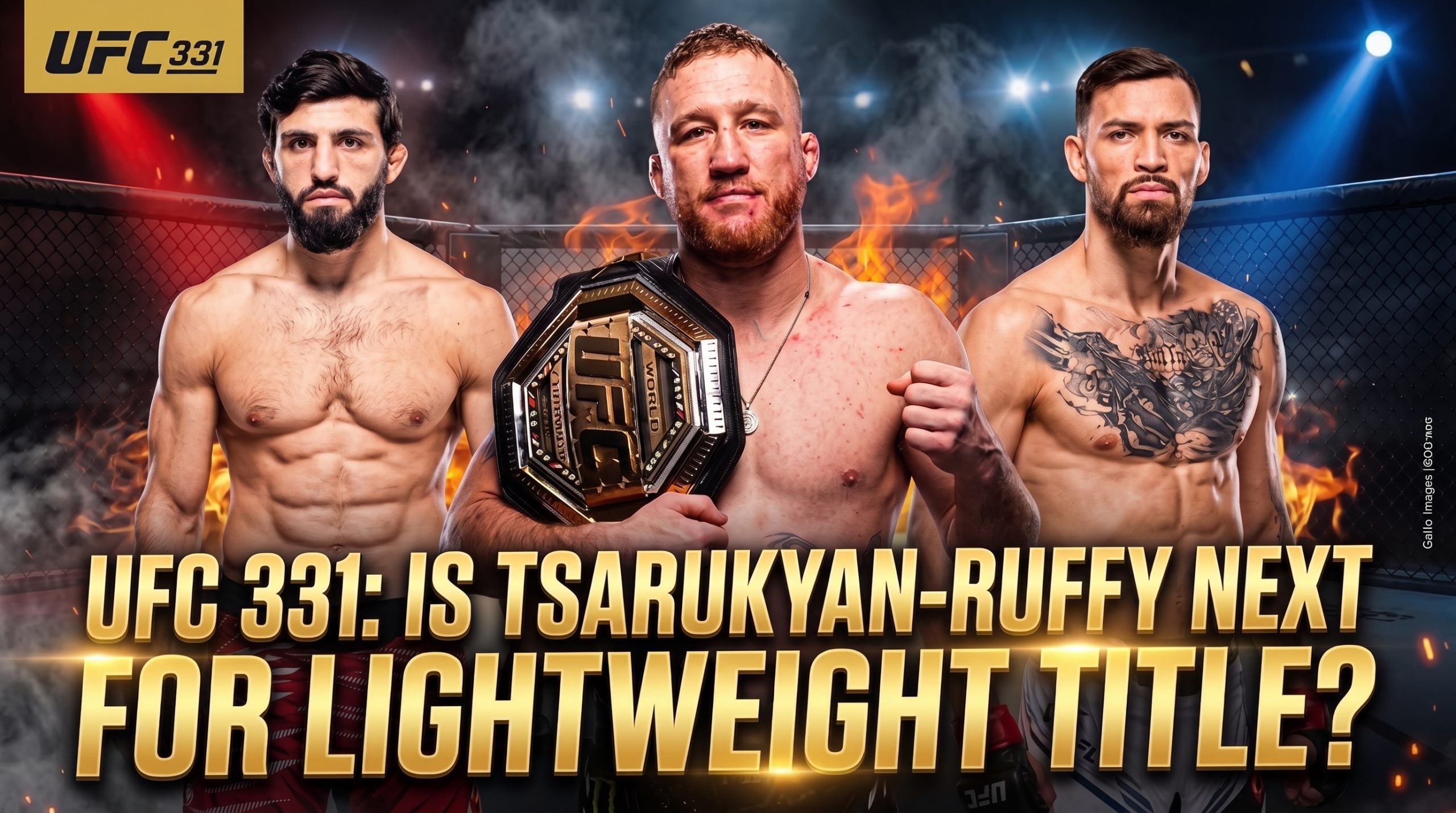
The UFC has given Arman Tsarukyan and Mauricio Ruffy five rounds in Saturday’s UFC 331 co-main event, a booking that plainly signals major lightweight stakes. But while the winner should emerge as a leading candidate to challenge champion Justin Gaethje, calling it a definitive No. 1 contender fight would be premature.
When UFC 331 arrives at Crypto.com Arena in Los Angeles on Sept. 19, the flyweight title rematch between Joshua Van and Alexandre Pantoja will officially close the show. Yet the bout likely to reshape the company’s 155-pound matchmaking may come one fight earlier. Tsarukyan versus Ruffy is not merely a collision between a long-established contender and an explosive newer force. It is the UFC’s attempt to clarify a division that has a champion, a former champion with immediate-rematch leverage, several recognizable names near the top, and no cleanly established next challenger.
The promotion does not routinely schedule non-title fights for five rounds. It has done so here, and that decision makes the intent difficult to miss: Tsarukyan and Ruffy are fighting over more than a ranking position. They are competing for the right to put themselves directly in the champion’s line of sight.
How the fight came together
This is a matchmaking decision born from opportunity, congestion and risk.
For Tsarukyan, the fight represents a route back into a title picture that has repeatedly seemed close enough to touch, then moved away. The Armenian standout has long been regarded as one of lightweight’s most complete athletes: a powerful pressure wrestler, a fast scrambler, a physically imposing clinch fighter and a competitor whose striking has become increasingly functional as his career has matured. His current record is listed at 23-3 overall and 10-2 in the UFC.
Yet a contender can be elite and still become difficult to place. The highest-ranked fighters can want title shots or marquee fights; rising contenders need opponents with enough standing to make a win meaningful. Tsarukyan, ranked No. 2 in the current landscape cited by recent coverage, needed an opponent who could preserve the magnitude of his own claim while also offering the UFC a fresh, marketable direction. Ruffy became that opponent.
Ruffy’s ascent has made the booking possible. The Brazilian enters the co-main event at 14-2 overall and 5-1 in the UFC, with a style built to generate attention: reactive movement, creative kicking, sharp counterstriking and genuine finishing danger.
More importantly, he has earned a substantial jump in competition. His recent run has included victories over Rafael Fiziev and Michael Chandler. That is why the UFC can credibly present Ruffy as more than a prospect being fast-tracked for promotional reasons. He is a contender who has gathered momentum, beaten recognizable opposition and now faces the opponent who can test virtually every remaining question about him.
The fight’s architecture is simple. Tsarukyan is the proven all-around threat seeking to reassert that he is the division’s most deserving active challenger. Ruffy is the dynamic striker trying to turn a rapid rise into an undeniable championship case. The booking lets the UFC answer both questions in one night.
The betting market reflects the gap in established resume while acknowledging Ruffy’s danger. Tsarukyan is around a -325 favorite and Ruffy around a +255 underdog as of the latest posted numbers.
A clash of styles and timelines
A five-round format changes the character of this matchup.
Over three rounds, Ruffy’s speed, unpredictability and ability to land a sudden momentum-changing shot make him hazardous from the opening bell. He does not need to out-wrestle Tsarukyan for 15 minutes if he can consistently force the Armenian to reset, make him pay for entries and capitalize on the exchanges that occur at mid-range. Ruffy’s chance lies in making the fight feel chaotic, denying predictable takedown sequences and proving that he can sustain poise when the more experienced fighter begins to pressure him.
Tsarukyan’s ideal fight looks substantially different. He should not treat this as a kickboxing showcase. His advantages are grappling pressure, physicality, transition ability and the capacity to make a fighter work everywhere. Ruffy has become one of lightweight’s most intriguing attacking fighters, but Tsarukyan offers the kind of opponent who can turn every exchange into a layered problem: defend the shot, survive the clinch, stand up from the mat, avoid being pinned to the fence, reset under pressure, and then deal with meaningful offense once back at distance.
Five rounds give Tsarukyan additional opportunities to drag the contest into that cumulative fight. If he can impose his wrestling without overcommitting into Ruffy’s counters, he can make the Brazilian carry a defensive burden that may grow heavier round by round. The favorite’s most persuasive path is not necessarily an early finish. It is to make Ruffy confront a level of sustained grappling, decision-making and fatigue management that he has not faced against a fighter of Tsarukyan’s caliber.
That is precisely why Gaethje described Tsarukyan as Ruffy’s “first ultimate test” in the UFC. The champion’s framing is useful, even if it also carries a degree of self-interest: he is evaluating a possible opponent, and Ruffy’s credentials are about to be measured against the most demanding style test available outside a title fight.
For Tsarukyan, however, the risk is just as real. A loss would not be a routine setback. A defeat to an ascending Ruffy could push him behind multiple title narratives while forcing him to rebuild through another difficult top-10 pairing. Tsarukyan has openly recognized the stakes, saying he is approaching the Ruffy bout like a title fight and fears a loss could end his championship ambitions.
The lightweight division’s unresolved picture
The central issue is that lightweight does not currently have a simple queue.
Gaethje holds the title after defeating Ilia Topuria in June, a result that transformed the division’s immediate political landscape.
An immediate rematch with Topuria remains a plausible option, especially because former champions are often afforded a direct path back when the first fight was significant and the rematch has public interest. Recent reporting has also suggested that Gaethje could be out for the remainder of 2026, which means UFC matchmaking has time to develop but also risks allowing the title picture to become stagnant.
Then there are the established names. Charles Oliveira, Paddy Pimblett, and other recognizable contenders all remain relevant, whether because of resume, popularity, recent positioning or the UFC’s preference for major-event marketability. The champion’s next fight is not decided by rankings alone; it never is, and the lightweight division is too star-rich to pretend otherwise.
That does not make rankings meaningless. It simply means a contender must have a case strong enough to survive the sport’s other forces: rematch possibility and expectations, timing, injury, availability, commercial value, prior wins, recent losses and the UFC’s desire to make the biggest possible fight at the right moment.
Tsarukyan understands that reality better than most. He can win on Saturday and still find himself confronted by a Topuria rematch or another booking that the UFC decides has greater event value. Ruffy faces a similar uncertainty, although an emphatic upset could make him impossible to ignore. A spectacular knockout of a top-ranked Tsarukyan would not just win Ruffy a fight it would create a new star, and new stars can move faster than the rankings suggest.
Should it be a true No. 1 contender fight?
The answer is yes in principle, but no as an unconditional guarantee.
The UFC should treat the winner as its leading fresh challenger for Gaethje, particularly if the result is decisive. A clear Tsarukyan victory would reinforce the argument that the most complete active contender deserves the opportunity he has chased for years. A clear Ruffy victory, especially a finish, would establish a compelling new threat with the type of offensive style that could make a Gaethje title defense feel urgent and distinct.
But “should challenge the champion next” is different from “must challenge the champion next regardless of circumstances.”
The strongest case for formal No. 1 contender status belongs to Tsarukyan if he wins convincingly. He is the established high-level lightweight, a fighter with a deeper body of work, and the matchup with Ruffy is dangerous enough that winning should not be treated as a mere obligation. Beating a dangerous rising contender over five rounds would demonstrate both quality and readiness. Tsarukyan does not need another placeholder bout if he handles business.
Ruffy’s case is more complicated, but not weak. If he beats Tsarukyan, he will have defeated a man positioned near the top of the division and answered the greatest question surrounding his rise: can the striker thrive when the opponent is elite, physical, relentless and capable of attacking every phase? That type of win can accelerate a championship opportunity. It should.
Still, the UFC should leave room for performance and context. A disputed split decision, an injury-shortened fight or a low-action contest may not settle enough. Nor should the promotion ignore Topuria’s rematch credentials if that is the matchup Gaethje and the UFC believe is most justified or commercially consequential. Neither fight has been formally promised that the winner will receive the next title shot and has said the promotion wants to assess how the fight plays out.
That is the reasonable position. Make the contest a de facto eliminator, but do not manufacture certainty before the evidence exists.
A strong finish changes everything. If Tsarukyan dominates and finishes Ruffy, he should be next. If Ruffy knocks out Tsarukyan in a manner that confirms his arrival as a legitimate elite lightweight, he should be next unless the UFC has already committed to a clearly justified Gaethje-Topuria rematch. If the bout is close, uneventful or controversial, the division remains open for a bigger conversation.
The verdict
Tsarukyan versus Ruffy is not an officially guaranteed title eliminator, and it should not be marketed as one if the UFC has not made that commitment. But it is absolutely the closest thing the lightweight division has to a live, meaningful No. 1 contender fight this weekend.
For Tsarukyan, this is the chance to transform an argument into a mandate. For Ruffy, it is an opportunity to go from dangerous breakout talent to a genuine championship threat. For Gaethje, it is a scouting assignment with immediate consequences.
The winner may not control every variable; Topuria’s rematch case and the UFC’s broader business plans remain central, but he will control the most important one: whether he leaves Los Angeles with a performance forceful enough that the champion has no better fresh challenger waiting.