
By The Numbers: Can Conor McGregor Come Back After 5 Years And Win As The Underdog?
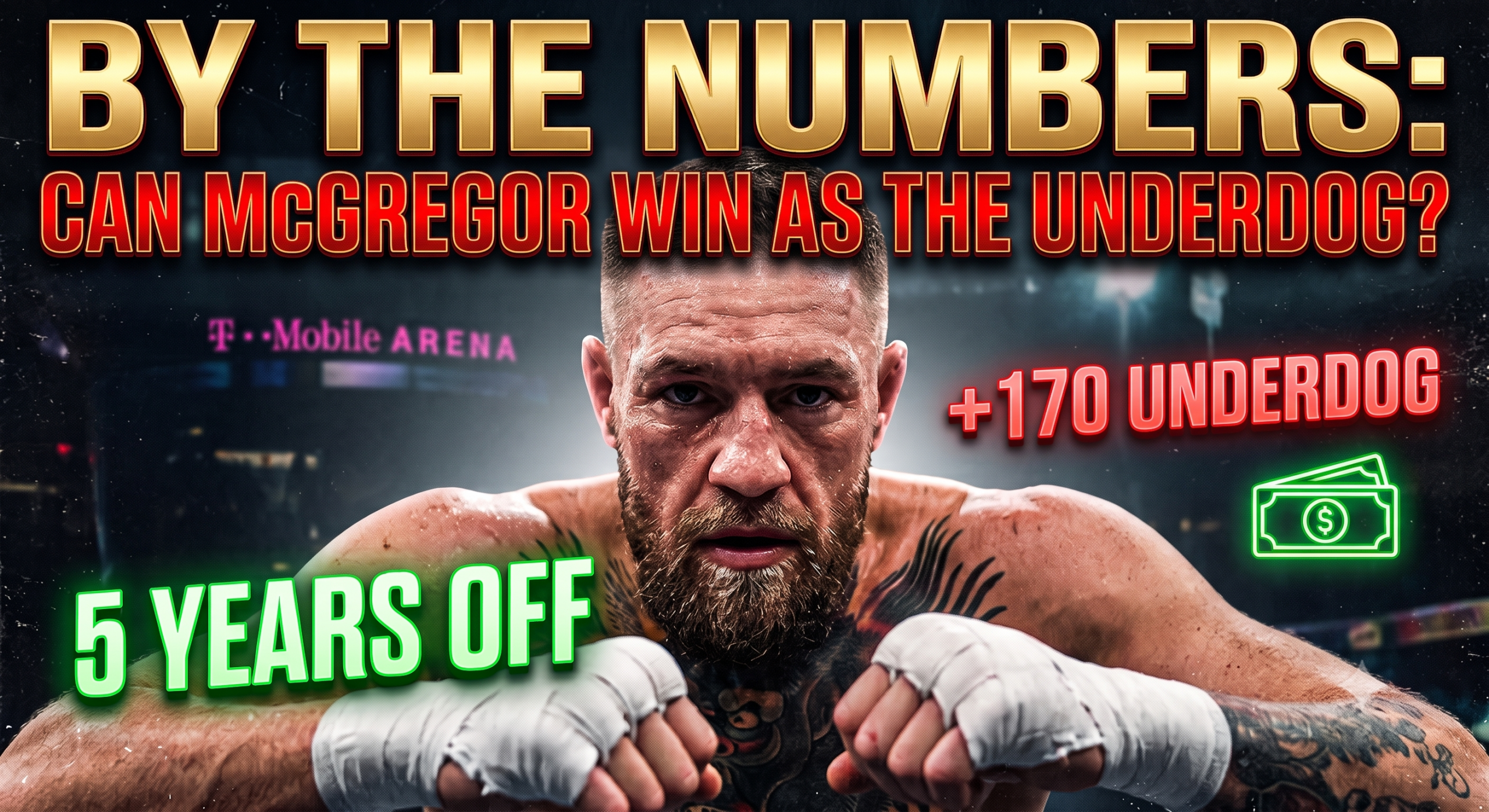
By the numbers, Conor McGregor’s return against Max Holloway is a classic question of timing, variance, and market memory: oddsmakers and prediction markets have framed him as a clear but dangerous underdog, and your job as a bettor is deciding whether that price is fat or fair.
This is less about nostalgia and more about whether a 37-year-old coming off a five-year layoff can still create enough chaos in the first ten minutes to break one of the most durable volume strikers in modern UFC history.
The Layoff: Five Years Out Of The Cage
McGregor’s last official UFC appearance came in 2021, meaning he will walk into UFC 329 with roughly a five-year competitive gap on his record. On paper, that is unprecedented for a headlining PPV star returning straight into the deep end against an active elite contender, especially at a stage of his career where age-related decline is expected rather than hypothetical. However, McGregor is your ordinary fighter, he is a special kind of athlete.
Bookmakers have clearly priced in this inactivity; early lines had Holloway as high as a -410 to -420 favorite, with McGregor around +290 to +320 at open, a gap that reflects not only the layoff but accumulated injury and durability questions. As fight week approached, the market settled with Holloway still in the -200 to -230 range across books, and McGregor anywhere from roughly +165 to +175 depending on the book.
From a betting perspective, five years away introduces three intertwined unknowns: conditioning over 25 minutes, timing and reaction speed, and his willingness to throw with the same conviction he once had after serious leg injury and long-term inactivity.
Unknowns tend to be punished by the market at the top end, and the spread here signals that most of the modeling is actively discounting McGregor’s historical peak in favor of recent reality and mileage.
McGregor As An Underdog: Historical Context
One of the key angles in this matchup is how rarely McGregor has actually been the betting underdog in his UFC career. Against Jose Aldo, Eddie Alvarez, and much of his featherweight run, the market treated him as the A-side, often pushing him into favorite territory on the back of sharp early money and public enthusiasm. His most famous underdog roles came against Dustin Poirier in the rubber match and Khabib Nurmagomedov at lightweight, with both bouts closing with McGregor in plus-money territory.
In those underdog spots, his results weren’t good: Poirier battered McGregor’s lead leg until he famously broke it at UFC 264, and Khabib dominated him in a one-sided fight. Taken together, McGregor has never “cashed” as an underdog in a small sample size at the UFC level
That matters because the current line against Holloway is one of the broadest underdog ranges of his UFC tenure, with around 35 percent, depending on the book, which is the lowest level of respect the market has ever given him in a headlining spot.
For bettors, this presents a different question than past McGregor dogs: you are not paying for the same expectations of competitiveness; you are paying for an aging knockout artist who’s yet to come away victorious in the underdog role in his UFC career.
The Current Market: Books And Prediction Markets
Looking at the current board, Holloway is a moderate favorite at traditional sportsbooks like FanDuel and DraftKings. Books also heavily shade Holloway inside the distance, with some operators hanging him around the -110 knockout or TKO, reflecting an expectation that volume and attrition win the day.
Prediction markets tell a similar story but in probability terms more familiar to data-driven bettors. Polymarket and Kalshi have Holloway trading at 65%, while McGregor is trading around 34-35%.
The alignment between traditional books and prediction markets suggests that there is no real split between sharp and casual traders or bettors. The consensus is that Holloway is the stable, trustworthy side and McGregor is the volatile wildcard.
Stylistic Snapshot: Volume Versus Volatility
At a pure stylistic level, the fight is a contrast between Holloway’s pace and McGregor’s precision. Holloway is a high-output, cardio-heavy striker who builds pressure and volume as fights go on, often adding layers to his combinations, switching between head and body, and weaponizing durability and recovery to drown opponents over multiple rounds. McGregor, by contrast, remains a southpaw sniper whose offense is built around timing, distance management, and the famous straight left hand, historically front-loaded into the first ten to twelve minutes of a fight.
In their first meeting years ago, McGregor relied heavily on that distance control and counter punching to outpoint a young Holloway, but the rematch is a different dynamic entirely: Holloway has matured into one of the best volume strikers in UFC history, and the fight is now scheduled for five rounds at a higher weight where durability, late-round cardio, and damage accumulation matter more than ever.
That raises an obvious risk for McGregor backers: if he cannot secure early momentum or heavily damage Holloway in the opening frames, the structural advantages of volume and pace tilt sharply toward the Hawaiian in rounds three, four, and five.
Early Rounds: McGregor’s Win Condition
The most compelling betting case for McGregor starts and nearly ends in the early rounds. The books have the belief that if he wins, it is far more likely via stoppage than a drawn-out decision over full 25 minutes. That dovetails with his historical profile: of his 22 professional wins, 19 have come by KO/TKO, and he has rarely needed, or succeeded, in winning long wars of attrition against opponents with superior cardio and durability.
From a tactical standpoint, McGregor’s best path is to reintroduce the fast, bladed stance that allowed him to attack with straight lefts, pull counters, and spinning kicks while limiting exchanges to his preferred timing windows.
Holloway can be hit early, especially before he calibrates distance, and the first two rounds are the portion of the fight where McGregor is most likely to find clean counters against a still-warming volume game.
Bettors targeting McGregor exposure may therefore prefer KO/TKO props and round-based markets that front-load his win condition, rather than relying on the broader moneyline where late-fight risk is baked in.
Betting Edge Or Just Storyline?
Ultimately, this fight sits at an intersection of nostalgia and numerical reality. The number on McGregor is one of the most generous underdog prices of his UFC headlining career, reflecting legitimate structural concerns about age, layoff, and matchup, but it also bakes in his enduring finishing upside as a southpaw striker with fight-ending power and historically elite timing.
Holloway, in turn, offers a more predictable, data-friendly profile: consistent volume, proven cardio, durability, and a stylistic template that has aged gracefully, all of which make him the “safe” side in the eyes of both bookmakers and prediction markets.
Whether there is genuine betting value depends on how much weight you give McGregor’s early-round volatility versus Holloway’s volume and cardio. If you believe the five-year layoff has turned McGregor into a purely name-brand underdog, then the market is probably right to price him as roughly a one-in-two proposition or less; if you see enough in the stylistic clash and his historical precision to justify that risk, then the plus-money on his knockout paths might look more attractive than the flat side.
In the end, the numbers frame a clear but unresolved question: is this the spot where an aging, inactive superstar catches lightning one more time, or the night where a prime, active champion of volume confirms everything the market has been saying all along?